
blood-g513e49303_1280

Chemical indicates the presence of human blood in the trailer

After detectives photographed the inside and took some items into evidence, they cleared the floor in order to apply a chemical known as Bluestar, which lights up blue when it comes into contact with human blood, Liddell said.

What did investigators find under Ruben Flores’ deck? Expert testifies in Kristin Smart trial

The Tribune: September 07, 2022

Traces of human blood were possibly found inside a trailer at Ruben Flores’ home, a San Luis Obispo County Sheriff’s Office forensic specialist testified Wednesday during the Kristin Smart murder trial.

Shelby Liddell, who spoke on the stand in Monterey County Superior Court, has been a forensic specialist for the Sheriff’s Office for about four years. She helped excavate parts of Flores’ Arroyo Grande property, in particular an area underneath his deck — where investigators believe Smart’s body was once buried after his son, Paul Flores, allegedly killed her in 1996. On Wednesday, San Luis Obispo County Deputy District Attorney Chris Peuvrelle walked Liddell through two 2021 excavations she did at Ruben Flores’ home. During the excavations, Liddell said, she helped dig at various areas and helped identify a stain discovered in the dirt beneath Flores’ deck.

Samples of the stain — which archaeologist Christine Arrington previously testified was likely from human remains — was collected as evidence and subsequently subjected to test for human blood and DNA, Liddell testified. She said she focused on carefully collecting soil from the darkest parts of the stain for testing. She said she also collected control samples of soil from various parts of the property, including under the deck, to ensure the samples from the stain could be tested accurately.
EXPERT: CHEMICAL INDICATES PRESENCE OF HUMAN BLOOD IN TRAILER

A cargo trailer was taken from Ruben Flores’ home to the crime lab annex for further testing, Liddell said on the stand Wednesday. The trailer belonged to Mike McConville, boyfriend of Ruben Flores’ ex-wife, Susan Flores. After detectives photographed the inside and took some items into evidence, they cleared the floor in order to apply a chemical known as Bluestar, which lights up blue when it comes into contact with human blood, Liddell said. The chemical may also react to some paints or varnishes, certain animal blood and cleaning chemicals.
luminol luminescence luminiscencia

“However the reaction is different” in those cases, she testified.

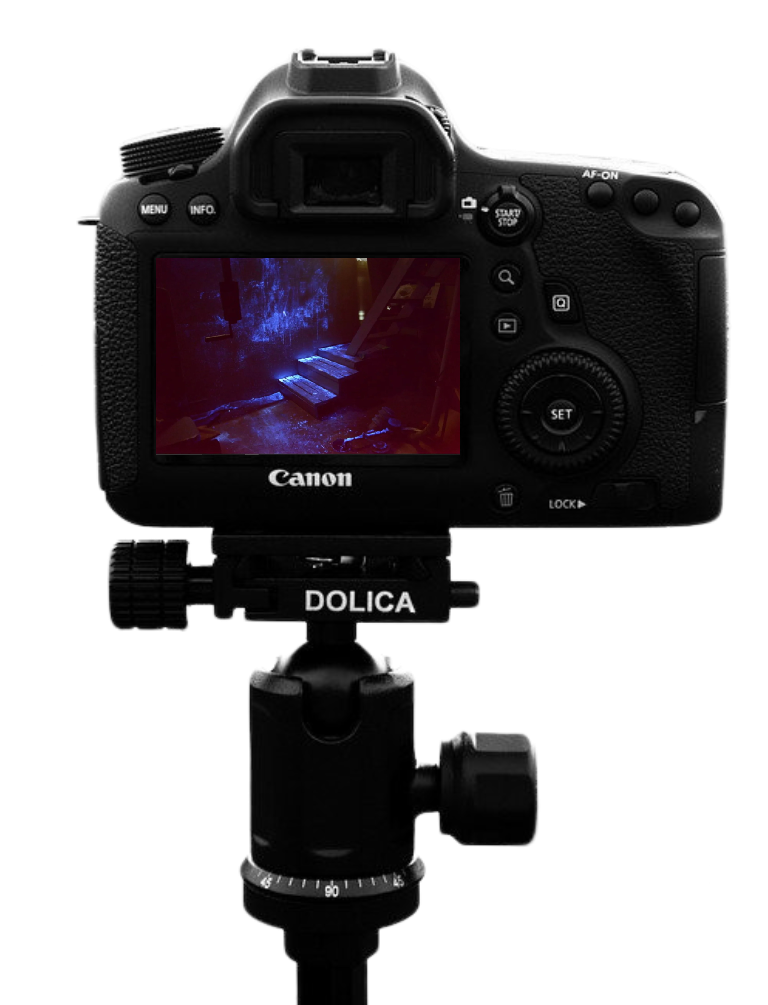
For example, Liddell said, when the chemical comes into contact with a cleaning chemical such as bleach, it more closely resembles a bright flash and is more white than blue. When it comes into contact with human blood, however, it is more of a slow blue glow — “like that photo,” she said, pointing to a photo of the blue glow emitted on the cargo trailer. The reaction site was on the floor of the inside of the side door of the trailer, the photo showed. While the Bluestar reaction is not direct evidence itself, “it is used as a presumptive to narrow down the search for collection for further testing,” Liddell said.

WITNESS CHANGED PREVIOUS TESTIMONY FOR ‘CLARIFICATION’

On cross-examination, Paul Flores’ defense attorney, Robert Sanger, noted that Liddell’s testimony had changed from what she said during the preliminary hearing — specifically about whether the stain underneath the deck was disturbed.

On cross-examination, Paul Flores’ defense attorney, Robert Sanger, noted that Liddell’s testimony had changed from what she said during the preliminary hearing — specifically about whether the stain underneath the deck was disturbed. In the preliminary hearing, Liddell stated that it did not seem the stain had been disturbed prior to excavation, but in her testimony Wednesday she said it had. When Peuvrelle asked her to explain her answer, Liddell testified she “was taking (Sanger) too literally” and thought he meant the stain itself, not the area around the stain. Liddell said she was provided transcripts of her testimony from the preliminary hearing and reviewed them before giving her testimony Wednesday, but had not conferred with the prosecution about changing her testimony.

She also did not review any reports indicating the change, she said. Liddell testified Wednesday that she decided to clarify her answer because she realized her previous testimony was not clear. Throughout her testimony, Liddell declined to answer questions about how the stain and soil interacted with one another because her expertise is in evidence and DNA collection. “I am not an expert in staining and soil. That’s why we brought in the archaeologists,” she said. This was a point that Ruben Flores’ defense attorney, Harold Mesick, focused on during Wednesday’s cross-examination.

Liddell spoke about taking samples from stained soil and discolored soil. After confirming Liddell did not consider herself an expert in staining and soil, Mesick asked her what the difference was between the two.

She did not immediately answer, and Mesick put a photo of the stain up on the projector and asked her to explain it. She said the larger section is a stain, and the different colors in the middle of the stain were discoloration. Also, while Liddell talked with the archaeologists at the scene, she decided what samples to take on her own, she testified. Liddell testified that no bones, teeth or hair were found at any of the excavations sites she examined — including sites at the Flores home, three in Huasna and one in rural Arroyo Grande, Liddell testified. “Any semi-permeable wraps?” Sanger asked, referring to the prosecution’s theory that Smart was wrapped in a semi-permeable wrap while buried underneath Ruben Flores’ deck. To her knowledge, no evidence of a semi-permeable wrap was found, Liddell testified. Court will resume Thursday with a “full day of testimony,” Monterey County Superior Court Judge Jennifer O’Keefe told the juries, urging them to be on time.
virtual

KU Leuven Students Investigate Virtual Crime Scenes

Investigating murders as a forensic expert...

(India Education : Apr 26, 2022)

Taking DNA samples, making blood traces visible with a chemiluminescent spray (‘Bluestar’) or with infrared light, searching for semen remains with blue light, visualizing fingerprints and taking photos: everything is possible.”

KU Leuven Students Investigate Virtual Crime Scenes

Investigating murders as a forensic expert: for many KU Leuven students of the Biomedical Sciences program it is a dream job, but it turns out not always easy to gain practical experience. Thanks to a new application, they can now practice their skills using virtual reality .

The virtual approach has many advantages, says Professor Bram Bekaert, lecturer of the Criminalistics course in the Master’s program in Biomedical Sciences. “The pandemic suddenly made it much more difficult for our students to investigate real crime scenes . But even before corona it was often a challenge for students to gain practical experience. This VR application is a very good alternative.”

Three murder scenarios

The new application looks a lot like a computer game, including a 3D environment, VR glasses and two hand controllers . Students find themselves in one of three possible scenarios: a double robbery murder, a double murder of passion, and a suspicious death that could be a murder or suicide.

Upon their virtual arrival at the crime scene, the students are briefed by a police officer. Then they can walk into the house and search. Bram Bekaert: “Just like on a physical crime scene , students can open cabinets and doors, identify traces and perform tests. Taking DNA samples, making blood traces visible with a chemiluminescent spray (‘Bluestar’) or with infrared light, searching for semen remains with blue light, visualizing fingerprints and taking photos: everything is possible.”

Due to the online follow-up of the recorded tracks and the tests performed, the teacher or the student can easily carry out an evaluation.

From crime scene to practice court

Students also learn how to avoid contamination of evidence. Touched the door handle without gloves or stepped through a trail of blood? Then the VR system taps you on your fingers. Bekaert: “The technology we use to investigate crime scenes is becoming more and more sensitive, so it is even more important than it used to be to ensure that no DNA from the investigator ends up in the crime scene samples or that DNA traces are left behind. exchanged between pieces of evidence.”

Students find themselves in one of three possible scenarios: a double robbery murder, a double murder of passion, and a suspicious death that could be a murder or suicide. After the students have completed their virtual research, they formulate various hypotheses and prepare a report.

 Bekaert: “In the long run, we also want them to practice defending that report in a kind of trial court. To do this, we work together with our colleagues from the Faculty of Law and Criminological Sciences: their future lawyers can then challenge our trainee experts.”

The police can also benefit from using this application. In reality, you can only properly investigate a crime scene once. By practicing in a virtual reality environment, points for improvement can be quickly identified or police officers can become acquainted with the challenges of investigating a crime scene.

This VR application was developed by the Biomedical Technology Lab in collaboration with the STEPS Skills Center and the Education Expertise Center of the Faculty of Medicine.

p07830vq-300x169

Forensics, the latest methods

When pollen and insect larvae are used to solve criminal cases and even historical enigmas...

This documentary takes a look at the fascinating resources of science for investigators.

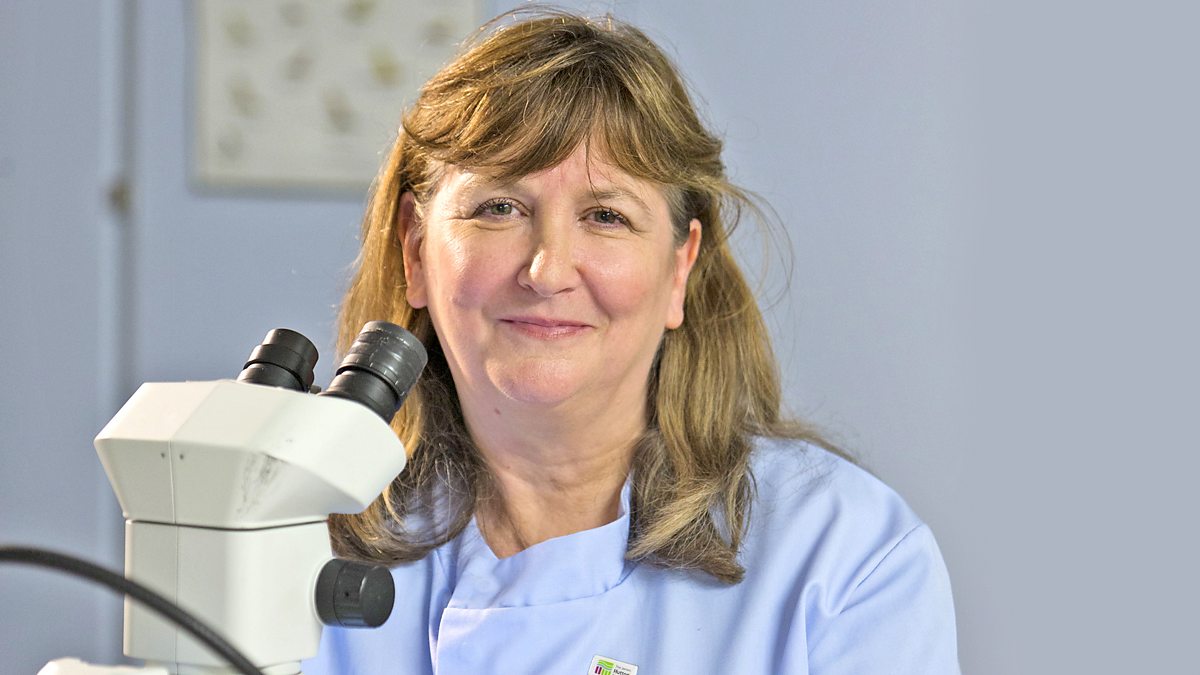
For Scottish researcher Lorna Dawson of the James Hutton Institute, soils, especially forest soils, can provide valuable clues to the location of a crime based on fingerprints.

Blood samples can also reveal important information: Philippe Esperança, a forensic scientist in France, is working to bring to light traces that are a priori invisible.

At the Institute of Forensic Medicine in Frankfurt, entomologist Jens Amendt works with flies and their larvae, which, when taken from a corpse, can accurately indicate the time of death.

Latest prowess

Used since the 1980s, DNA testing is probably the most important revolution in the history of criminology. As a new and indispensable ally in judicial investigations, it has led to the creation of a true scientific police force and the development of new forensic methods. With the enlightenment of researchers, this documentary offers a panorama of the latest prowess and promise of science in order to break through the most persistent enigmas.

Relatively recent in Europe, the analysis of pollen allows to identify those who were near a corpse, to know the places frequented by the deceased before his death or the season in which he died. The long life span of pollen ensures the preservation of traces dating back thousands of years. In Vienna, Martina Weber’s research has helped to solve crimes and to study historical events such as Pompeii.

finger-2081169_1280-300x169

How does the scientific police work?

How does the scientific police work?
(Le Mag de France Bleu Poitou)

Television loves forensics, because there are crimes, investigations, motives, and we get to see the daily lives of police officers and forensic scientists.

A short history of forensics

Before the first tools of forensic science, testimonies and confessions were the basis for convincing a suspect of his guilt. Alphonse Bertillon (1853 – 1914) founded the first police laboratory for criminal identification in 1882. He constituted the basis of forensic anthropometry, which allows the identification of people.

Ten years later, Francis Galton introduced systematic identification by fingerprints. Other valuable tools in a criminal case are the presence of traces, photos of the scene and a map of the scene. The forensics team makes observations at the scene, verifies and cross-checks the information gathered. It uses all techniques to materialize the facts.

In which cases does the forensic science department intervene?

The daily work of the forensic police of Poitiers is to intervene – in the order of the number of cases – on burglaries, robberies, discovery of stolen vehicles, corpses (found on the public highway, unidentified, suspicious deaths…), violence to persons, damages, fatal accidents, work accidents, rapes and drug trafficking.

In France in 2020, the police made 350 000 interventions and 50 000 identifications. In Poitiers, they made 2,000 trips and 250 identifications.

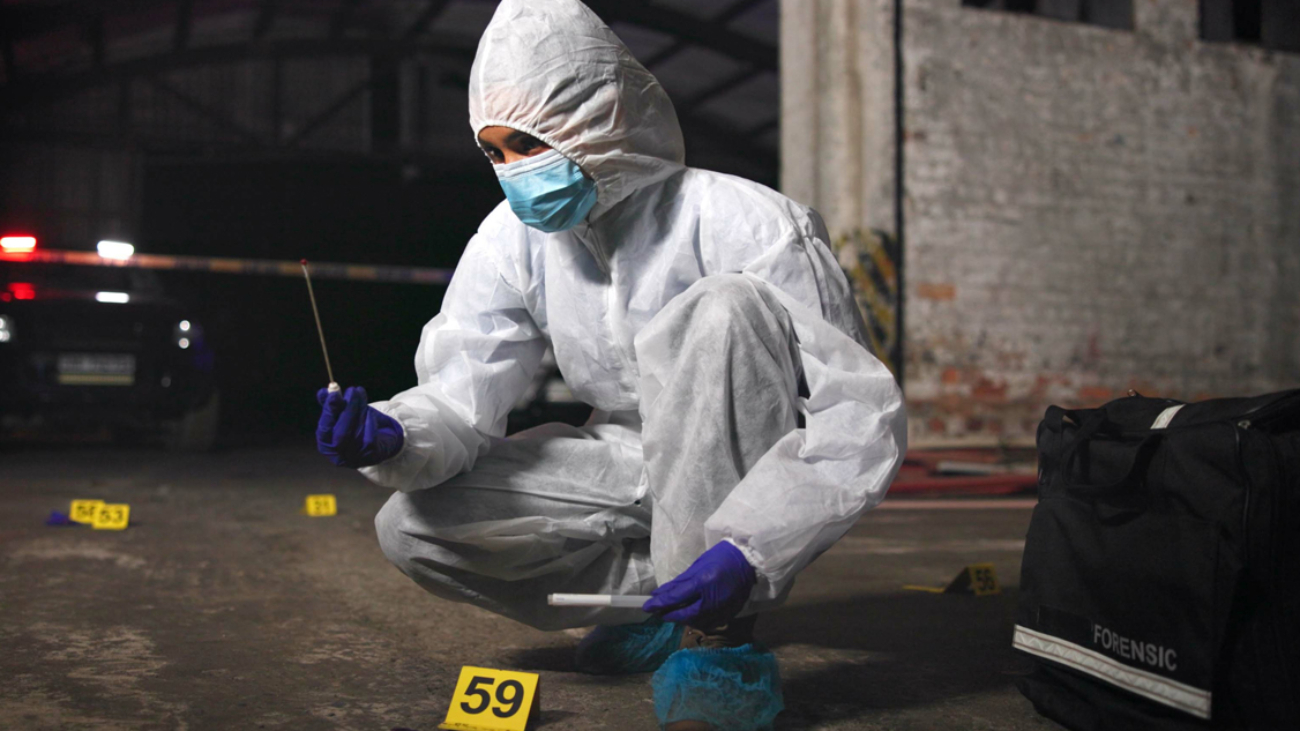
The forensic police look for material evidence following a very precise protocol. At the scene, they start by taking pictures to freeze the scene, look for traces and clues, install riders (these small numbers that identify the objects in the scene on the pictures) and take samples (objects, weapons).

The tools of forensic science

A number of samples are taken from a crime scene and from the suspect(s): fingerprints, hair, semen, gunshot residue on the shooting hand, presence of blood. To identify the presence of blood that is not visible to the naked eye, because the scene was cleaned before the police arrived, the forensic science team uses Bluestar to reveal the erased traces. The luminol makes the iron in the blood react.

The Poitiers crime lab is a pilot site in France for the digital forensics service.

Forensic medicine and DNA in the service of the truth

Forensic medicine is an essential tool of the scientific police. The autopsy is used to determine the circumstances of the death. Forensic scientists perform two types of examinations:

external examination of the body to determine ante-mortem and post-mortem trauma. The autopsy is an opening of the body to identify types of trauma, violence, blows, to take samples, to see the state of the lungs (in case of drowning) and to identify a body in bad condition, by taking a sample from the femur. The forensic pathologists will submit a forensic autopsy report.

DNA is a tool used on a daily basis by forensic scientists, including for burglaries. DNA is often a hope for cold cases, those cases that have remained unsolved for years (like the Grégory case or the Omar Raddad case). To be efficient, it is necessary to have a large quantity of quality samples and a good conservation of the seals, because the enemies of DNA are known: light, humidity, heat, UV rays…